
Break-even ROAS: when an ad is actually working
“What ROAS do I actually need?”
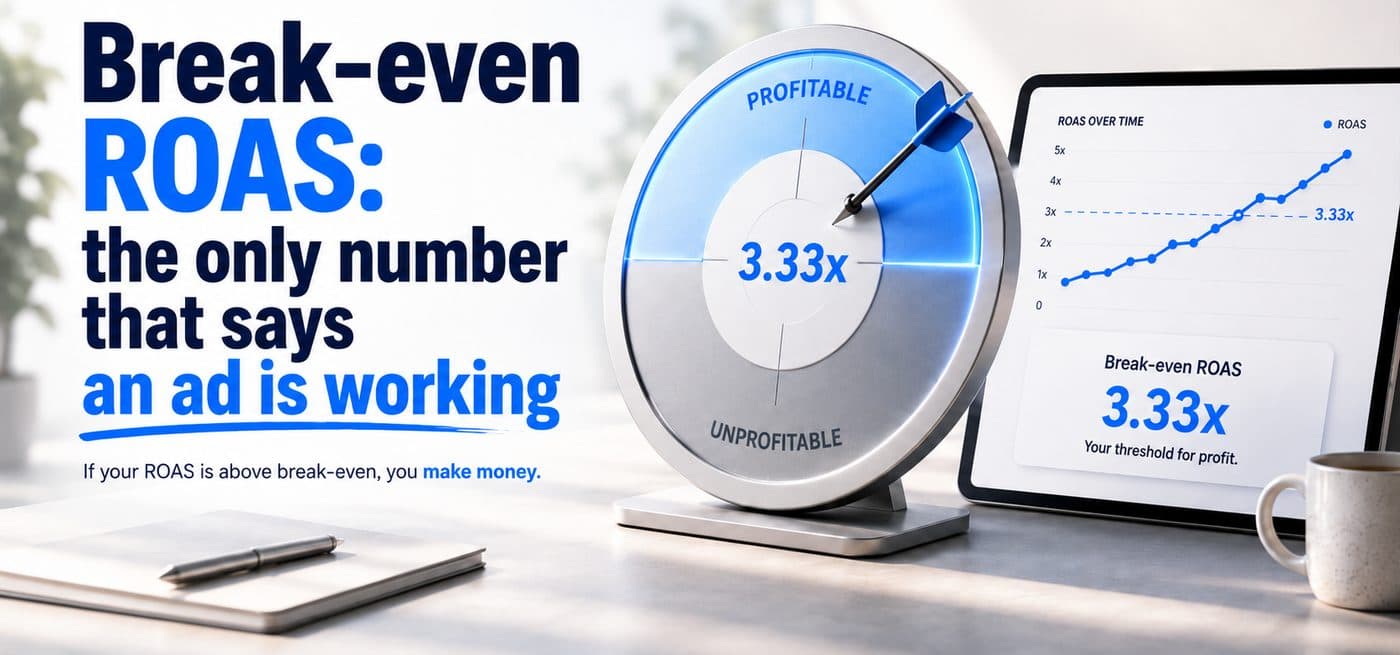
Ad accounts are routinely measured against a round-number ROAS target – 2, 3, 4 – that nobody can explain the origin of. The correct number is not a matter of taste. It falls out of your gross margin, and it is different for every business and often for every product.
The one line that gives you the number
Break-even ROAS is the point where the gross profit an order generates exactly equals what you paid to win it. Since gross profit is revenue times margin, and you break even when margin × revenue = spend, the target is simply the reciprocal of your margin.
1 ÷ contribution margin
At a 62% contribution margin: 1 ÷ 0.62 = 1.61. Below a reported ROAS of 1.61, every additional order loses money.
Profitable. At 62% margin you break even at 1.61. Every 100 spent returns +49 in gross profit.
This is why a shared industry benchmark is meaningless. A supplement brand at 80% margin breaks even at 1.25. An electronics reseller at 18% margin needs 5.6 before a cent of profit appears. Both could be told to “aim for 3” by the same agency.
| Gross margin | Break-even ROAS | What a ROAS of 3.0 means |
|---|---|---|
| 80% | 1.25 | Comfortably profitable – probably under-spending |
| 62% | 1.61 | Healthy, with room to scale |
| 45% | 2.22 | Profitable but thinner than it looks |
| 30% | 3.33 | Losing money at ROAS 3.0 |
| 18% | 5.56 | Losing money badly at ROAS 3.0 |
Which margin – and why accounting COGS is not enough
Accounting COGS is narrower than people assume: under IAS 2 it is purchase and conversion cost, not payment fees, outbound shipping, returns or discounts. Those are real and they scale with every order, so a target derived from accounting COGS alone is set too low and loses money quietly at volume. The figure to use is contribution margin – what is left of an order after everything that scales with it.
- Cost of the goods themselves, landed – including freight in and customs.
- Payment processing, typically 1.5–2.9% plus a fixed fee per order.
- Pick, pack and outbound shipping, including whatever you subsidise.
- Expected returns, weighted by category – apparel is not electronics.
- Discounts and codes actually redeemed, not the list price.
Why break-even is a floor, not a target
Hitting exactly break-even means the campaign paid for itself and contributed nothing to rent, salaries or your own time. Break-even ROAS tells you where to stop, not where to aim. Where to aim depends on what the customer does next – which is the subject of the cohort article – and on how much fixed cost the channel has to carry.
1 ÷ (gross margin − desired contribution rate)
At 62% margin, wanting 20 points of contribution left over: 1 ÷ (0.62 − 0.20) = 2.38.
The mistake this fixes
When a target is inherited rather than derived, two failures follow, and they are opposite. High-margin businesses throttle campaigns that were making money, because 2.1 looked disappointing next to a target of 3. Low-margin businesses scale campaigns hard, hit their target, and cannot understand why the bank balance keeps falling. Both are solved by one division.
In short
- ✓Break-even ROAS is 1 ÷ contribution margin. Derive it; never inherit it.
- ✓Use contribution margin – goods, fees, shipping, returns, real discounts.
- ✓A ROAS of 3.0 is excellent at 80% margin and loss-making at 30%.
- ✓Break-even is where to stop, not where to aim.
Where this method runs out
Everything above works in a spreadsheet. Keeping it current, and matching every order back to the ad that actually caused it, is the part that does not. That is what Kepra does – and the demo runs on sample data with no signup, so you can judge it before believing any of this.
Open the demo →Read next
How to read a cohort without a data team
First-order ROAS judges a customer on the day you met them. Here is how to build a simple cohort view in a spreadsheet and find out what a channel's.
Marginal ROAS: the number that decides “spend more?”
Average ROAS describes money you already spent. The decision in front of you is about the next euro. Here is how to measure marginal return and find the.